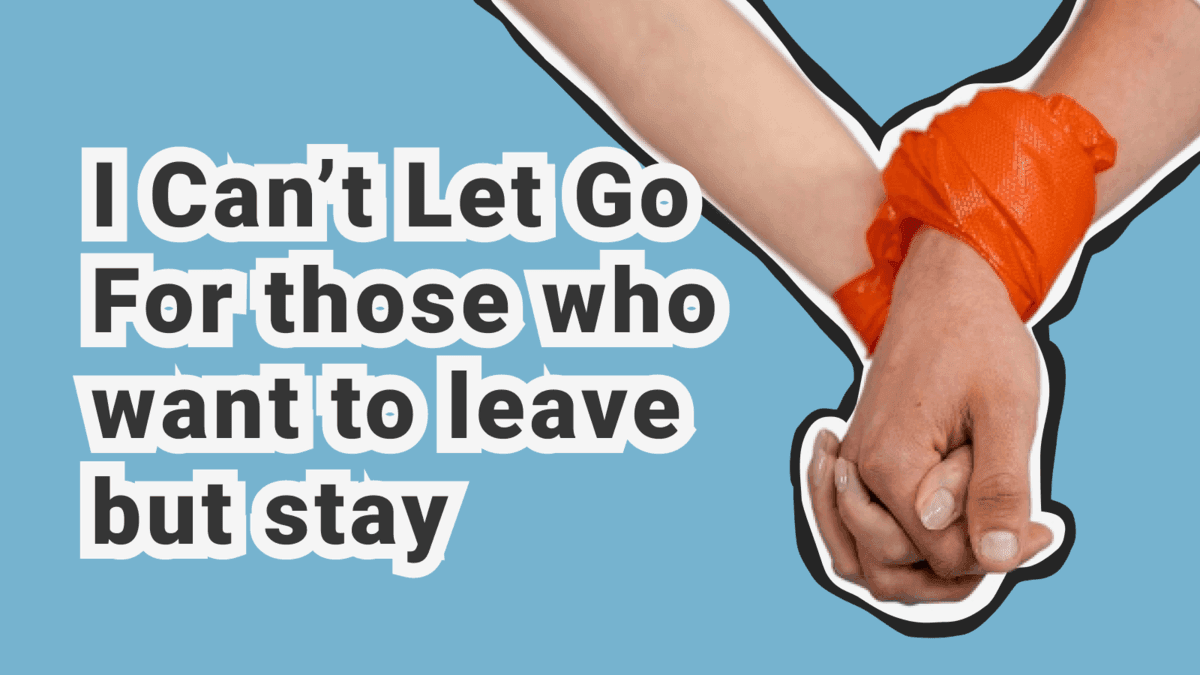
I Can't End My Relationship: Why Can't We Let Go of a Relationship?
I can't end my relationship. Why can't I leave even though I want to break up? Why do some people struggle to end a relationship even after deciding that it should be over? We explore the psychological dynamics behind being unable to let go of a relationship through attachment theory, Mary Ainsworth, John Bowlby, adult attachment, Erich Fromm, and Byung-Chul Han.
Sometimes the question isn't whether to end the relationship. Some people cannot leave because they don't want to end their relationship. Others have already decided that the relationship needs to end; yet somehow, they still cannot bring themselves to have that final conversation.
You may know that the relationship is no longer what it used to be. You may have noticed that the same problems keep happening, that you feel increasingly alone within the relationship, or that you no longer see your future in it. Perhaps you have even told yourself many times: "I need to end this relationship." You may have had the breakup conversation in your head, thought about what you would say, or perhaps even written the message. But you just cannot send it.
Because once the decision becomes clear, other questions begin to appear:
"What if I regret it?"
"What if I hurt them badly?"
"What if I miss them terribly after we break up?"
"What if I never find a relationship like this again?"
Sometimes, you spend a beautiful evening together without saying anything, and suddenly all the certainty you had in your mind begins to shake. "Maybe things aren't actually that bad." Then the same problem happens again. And you find yourself back at the same sentence:
"I know I need to end my relationship, but why can't I do it?"
However, the experience of being unable to end a relationship does not only occur in people who have decided to break up.
Sometimes a person does not want to let go of the relationship itself; sometimes they are afraid of being alone, being abandoned, or losing someone they love. And sometimes, rather than holding on to the relationship as it exists today, they hold on to how it used to be or how they believe it could become in the future. Therefore, it is not possible to find a single psychological explanation beneath the sentence "I can't end my relationship."
This experience may involve many different processes, from the need for attachment to the fear of separation, from habit and loneliness to past experiences and the identity a person has built within the relationship. From a psychological perspective, the real question is therefore not simply: "Do I still love them?"
Sometimes, more important questions are:
"Am I genuinely choosing to stay in this relationship, or am I afraid to leave?"
"Am I afraid of losing my partner, or the life I have built with them?"
"Do I love the relationship as it is today, or do I love what it used to be?"
In this article, we will explore the experience of being unable to end a relationship through attachment theory, developmental psychology, adult romantic relationships, cognitive and behavioral processes, Erich Fromm's ideas about love, and Byung-Chul Han's reflections on love.
Why Can Ending a Relationship Be So Difficult?
The end of a relationship is not simply the end of communication between two people. Relationships gradually become part of everyday life. The time spent together, shared plans, routines, expectations about the future, and the way a person defines themselves within the relationship can gradually create a powerful psychological structure.This is why, when a breakup happens, the person who is lost may not be the only thing being lost.
A person may also lose:
- the future they imagined building together,
- the routines of their daily life,
- the relationship in which they felt they belonged,
- the emotional security they received from their partner,
- the identity they had come to define as "we."
This is why, in some breakups, a person is not only separating from someone, but also from the world they built with that person.
And this world does not necessarily have to be entirely negative. There may be love, intimacy, beautiful memories, and a genuine bond within a relationship. At the same time, the relationship may still fail to meet the person's needs. These two realities do not cancel each other out. Loving someone does not necessarily mean that the relationship must continue.
Why Can't You Leave Even Though You've Decided to?
Sometimes a person has actually made a significant decision about the future of their relationship. They believe that the relationship is no longer good for them. They see that the same problems keep repeating. They may even have admitted to themselves for a long time that they no longer want the relationship to continue.But making a decision and taking the action required by that decision are not the same psychological process.
The mind may say: "I need to end this relationship."
At the same time, emotions may say:
"But I don't want to hurt them."
"What if they become devastated?"
"What if I regret it later?"
"What if I end up alone?"
In this situation, a person may begin struggling less with their decision and more with the emotions that the decision will create. Postponing the breakup conversation can provide temporary relief. You tell yourself: "I'll tell them tomorrow."
Your anxiety decreases. But the relationship continues, and the underlying problem remains. After a while, the same thought returns: "I need to end this relationship." A cycle can develop:
Decision → anxiety → postponement → temporary relief → relationship continues → renewed discomfort → decision again
Therefore, constantly postponing a breakup conversation does not necessarily mean that a person is satisfied with their relationship. Sometimes, it simply means they are avoiding the intense emotions that the breakup may create. There is an important psychological distinction here: "I don't want to leave." and "I'm afraid to leave." are not the same thing.
Why Does Such a Gap Develop Between Deciding and Leaving?
Human behavior is not shaped by logical decisions alone. Believing that a relationship should no longer continue does not necessarily mean being emotionally prepared for what will happen after the breakup. A breakup involves loss, uncertainty, and change. For this reason, a person may experience intense anxiety even after making a decision they believe is right. A breakup can become even more difficult for people who feel responsible for how the other person will feel."I don't want to hurt them."
"How am I supposed to do this after all these years?"
"They have invested so much in me."
"What if they see me as a bad person?"
These thoughts can keep a person in a relationship.
However, continuing a relationship simply so that the other person does not get hurt may not always lead to a healthy outcome for either person. A person may remain physically present in the relationship while becoming emotionally distant from it. In this situation, the relationship may appear to continue, while internally, the person may have already begun the process of leaving.
Are We Unable to Leave Because We Are Attached, or Because We Are Afraid of Losing?
Attachment theory is an important starting point when trying to understand how a person behaves in close relationships. John Bowlby proposed Attachment Theory, arguing that relationships formed with caregivers early in life play an important role in the development of a sense of security.One of the most important researchers in this field was Mary Ainsworth.
The famous "Strange Situation" studies conducted by Ainsworth and her colleagues demonstrated that children can respond differently when separated from and reunited with their caregivers. These studies provided an important foundation for understanding secure and insecure attachment patterns. In experiences of secure attachment, a child may learn that although a caregiver can sometimes become unavailable, the relationship itself does not completely disappear.
Over time, this can create an important psychological foundation: "Even if someone I am close to moves away from me, the bond does not completely disappear." In insecure attachment patterns, experiences of separation, closeness, and reunion may be experienced differently. It would not be accurate to say that these early experiences directly determine romantic relationships in adulthood.
However, attachment research suggests that relational expectations formed early in life can influence how people experience closeness, trust, separation, and abandonment in adulthood. For this reason, while separation may simply mean:
"A relationship is ending." to one person, it may feel like a much deeper threat to another:
"I'm losing the person who loves me."
"I'm alone now."
"I'll never be able to trust anyone again."
"If they left me, I must not be valuable enough."
The important point here is that these thoughts do not necessarily reflect reality; they may nevertheless feel extremely real because of a person's past relational experiences.
Mary Ainsworth and Our Need for Security in the Face of Separation
Ainsworth's work offers an important perspective showing us that attachment does not simply mean "loving someone." Close relationships are also connected to a sense of security and availability. For this reason, over time, a romantic partner can become more than someone a person loves; they can also become an important source of emotional security.Research on adult romantic relationships has supported the importance of this bond. In a 1987 study, Cindy Hazan and Phillip Shaver conceptualized romantic love as an attachment process and drew attention to similarities between adult romantic relationships and attachment processes. This perspective suggests that explaining the difficulty of someone who says "I can't end my relationship" solely through the intensity of their love may not be enough. Because other processes may also be involved:
Fear of abandonment.
Fear of being alone.
Fear of feeling worthless.
Uncertainty about the future.
The belief that they may never find another relationship.
Fear of losing a familiar sense of security.
Therefore, sometimes a person may remain in a relationship not because they do not want to leave, but because they struggle to cope with the emotions that leaving would create.
"Am I Afraid of Losing Them, or Am I Afraid of Being Alone?"
When we consider ending a relationship, it is important to distinguish where the fear we experience is actually coming from. Because sometimes a person is genuinely afraid of losing their partner. Other times, they are more afraid of the emptiness that will emerge in the partner's absence. Although these two experiences may look similar, they are not psychologically identical.For example: "I want to be with them."
is not the same as: "I don't know what I'll do without them."
The first expresses a desire for the relationship itself, while the second may be about the uncertainty and loneliness created by separation.
Similarly: "I miss them."
does not necessarily mean the same thing as: "I felt valuable when I was with them."
This distinction can be important in understanding why a person cannot leave. Because sometimes a person may not be attached only to another individual, but also to the psychological function that person fulfills in their life.
Sometimes What We Can't Let Go of Isn't the Person, but the Past of the Relationship
One of the hardest things to let go of can sometimes be not the relationship itself, but the version of it we believe it could become."It will get better one day."
"If I am a little more patient, they will change."
"Once this period passes, everything will be beautiful again."
"We can become the way we used to be."
These thoughts can sometimes cause a person to form an attachment not to the relationship as it exists today, but to what it might become in the future. This can create a relationship caught between the past and the future. The person is unhappy with the relationship as it exists today.
But they remember the good times from the past. And they believe that everything might get better in the future. They may begin living between the reality of today, the memories of the past, and the possibility of the future.
In this situation, an important question to ask yourself is: "If this relationship continued exactly as it is today, would I still choose it?" Because sometimes what keeps us in a relationship is not the relationship itself, but the hope that it will change.
"What If I Never Find Someone Like Them Again?"
One of the strongest reasons people may struggle to end a relationship is uncertainty about the future. A person may clearly see the problems in their current relationship, but if they cannot imagine an alternative future, they may hold on more tightly to what they already have.Thoughts may arise such as:
"What if I never find someone who loves me like this again?"
"What if I never build a connection like this again?"
"What if I end up alone?"
"What if I regret breaking up?"
There is an important psychological distinction here. Instead of evaluating whether the current relationship makes them happy, a person may begin focusing on whether they will find someone better in the future. But these are two different questions.
"Is this relationship good for me?" and "Can I find something better?" are not the same question. You do not need to know whether another person will appear in your future in order to evaluate whether your current relationship is right for you.
Why Does Postponing a Breakup Feel Good Temporarily?
Not having the breakup conversation can provide genuine relief in the moment. You postpone the conversation. Your anxiety decreases. You spend a normal evening with your partner. For a while, everything seems fine. And you may tell yourself: "Maybe I really don't want to break up after all."However, it is important to distinguish temporary relief from long-term needs. Sometimes the reason you feel relieved is not that the relationship has improved, but that the conversation you were afraid of has not happened yet. This is why you might ask yourself: "When I postpone the conversation, is my relationship actually getting better, or is my breakup anxiety simply going down?"
This distinction can be important in separating the decision to end a relationship from the behavior of avoiding a breakup.
Erich Fromm: The Difference Between Love and Dependence
The difficulty of ending a relationship can also be examined not only through clinical psychology, but through the nature of love itself.In The Art of Loving, Erich Fromm approaches love not simply as possessing someone or receiving something from them, but as an active process involving care, responsibility, respect, and mutual growth.
For Fromm, mature love does not mean becoming completely dependent on another person. This distinction raises an important question when it comes to being unable to end a relationship: "Am I staying because I love this person, or because I feel incomplete without them?"
There may not be an easy answer. Because love and dependence are not necessarily two completely separate experiences. A relationship can contain love while also involving intense dependence, fear, or insecurity.
Therefore, the question is not simply:"Do I love them?"
One of the more important questions is: "How much have love and fear become intertwined in this relationship?"
Byung-Chul Han: What Are We Actually Losing When We Leave a Relationship?
Another dimension of being unable to end a relationship concerns how modern people experience love. In The Agony of Eros, Byung-Chul Han argues that the way modern society relates to the "Other" is gradually changing. According to Han, love is not about consuming someone who resembles us or encountering a mirror that simply confirms who we are.Love involves encountering an Other that allows us to move beyond the boundaries of ourselves. This idea raises an interesting question about being unable to end a relationship: Are we unable to leave because we are truly attached to the relationship, or because we are afraid of losing the story we have created about ourselves within that relationship?
Because long-term relationships do not simply connect two people. Over time, they create a "we." I and you gradually become we. Shared memories, plans, friendships, routines, and visions of the future strengthen this sense of "we." For this reason, separation is sometimes more than the loss of a partner.
It is the loss of a world through which a person has come to define themselves.
Perhaps this is why some people, when considering ending a relationship, are afraid not only of losing their partner but also of losing the person they would become without the relationship.
Being Unable to Let Go of a Relationship Is Not the Same as Wanting to Stay in It
Sometimes a person tells themselves for a long time: "I guess I still want them." Because they cannot leave. Yet drawing conclusions from a behavior without understanding why the behavior occurs can be misleading.A person may not leave a relationship because they:
- genuinely love their partner,
- are afraid of being alone,
- do not want to hurt the other person,
- are attached to the past,
- believe the relationship will get better,
- are afraid of losing their routines,
- are struggling because of financial or social reasons,
- are avoiding the uncertainty they may experience after the breakup.
Therefore, "I still haven't been able to leave" does not by itself mean "I want to stay in this relationship." Sometimes there can be a gap between a person's behavior and their conscious decision. Understanding the reason behind this gap can be a more helpful starting point than blaming yourself.
Do You Really Want to End the Relationship?
There is no single correct answer when it comes to deciding whether to end or continue a relationship. However, a person can ask themselves certain questions to better understand their own experience:Do I want to stay in this relationship, or am I afraid to leave?
Do I miss my partner, or do I miss who I was when I was with them?
Do I love the relationship as it is today, or do I love what it used to be?
If this relationship continued for another year without changing, would I want that?
When my partner is no longer in my life, what am I most afraid of losing?
Am I afraid of being alone, or do I genuinely want to continue building a life with this person?
Is there a concrete reason to believe the relationship will change, or am I simply hoping that it will?
Does the thought of separation make me sad, or does it make me afraid?
The purpose of these questions is not to immediately lead someone toward a breakup decision. But sometimes the reason a person cannot decide is not that the options are unclear, but that they have not yet recognized which emotion is directing their decision.
The End of a Relationship Does Not Mean That What You Experienced Was Meaningless
When we talk about relationships, separation is often viewed as a failure. But the end of a relationship does not mean that the relationship was never real. Some relationships accompany us during particular periods of our lives. They can teach us about intimacy, conflict, boundaries, our needs, or ourselves. However, the fact that a relationship has an important place in our lives does not mean that it must last forever.The end of a relationship does not mean that what you experienced was meaningless.
Sometimes letting go of a relationship does not mean that you never loved it; it means accepting that it can no longer continue in its current form. For this reason, when we hear the sentence "I can't end my relationship," we should not always look only for love underneath it.
Sometimes there is a need for attachment, sometimes a fear of abandonment, sometimes loneliness, sometimes habit, sometimes anxiety about the future, and sometimes a person's definition of themselves through the relationship.
And all of these can exist at the same time.
Conclusion: Why Is Letting Go So Difficult?
Leaving a relationship is not simply about moving away from another person. Sometimes it requires facing attachment needs shaped in childhood, the fear of loneliness, beautiful memories from the past, hopes for the future, and the stories we have created about ourselves. From Mary Ainsworth's attachment research and Bowlby's attachment theory to research on adult romantic relationships, Erich Fromm's understanding of love, and Byung-Chul Han's reflections on modern love, different perspectives remind us of something similar:A person can become attached not only to another individual, but also to the bond they have created with that person and the world that bond has created within them.
This is why sometimes the hardest question is not: "Do I still love them?"
The harder question may be: "Am I truly choosing to stay with them, or am I afraid of being without them?"
Approaching this question honestly does not require making an immediate decision about the future of the relationship. But it can help a person begin to separate their emotions, needs, and fears from one another. Because sometimes there is much more beneath the inability to end a relationship than love alone.
And when we begin to understand what we are holding on to, we can also begin to see more clearly what we want to let go of and what we want to protect.
If you find yourself stuck in the same cycle even though you want to end your relationship, struggling to make a decision, or experiencing intense anxiety at the thought of separation, you do not have to make sense of this process on your own.
Psychological support can help you explore more closely what you are experiencing in your relationship, what you are holding on to, and where the emotions that make it difficult to leave may be coming from. Sometimes, before making a clear decision, simply taking a closer look at your own feelings in a safe space can be a meaningful place to start.
References
- Ainsworth, M. D. S., Blehar, M. C., Waters, E., & Wall, S. (1978). Patterns of Attachment: A Psychological Study of the Strange Situation. Lawrence Erlbaum Associates.- Bowlby, J. (1969). Attachment and Loss: Vol. 1. Attachment, Basic Books.
- Bowlby, J. (1973). Attachment and Loss: Vol. 2. Separation: Anxiety and Anger. Basic Books.
- Fromm, E. (1956). The Art of Loving. Harper & Brothers.
- Hazan, C., & Shaver, P. (1987). Romantic love conceptualized as an attachment process. Journal of Personality and Social Psychology, 52(3), 511–524.
- Han, B.-C. (2017). The Agony of Eros. MIT Press.
- Johnson, S. M. (2008). Hold Me Tight: Seven Conversations for a Lifetime of Love. Little, Brown Spark.
- Gottman, J. M., & Silver, N. (1999). The Seven Principles for Making Marriage Work. Crown.
To create a session
You can quickly create a session request via WhatsApp or email by choosing the therapy package that best suits you.