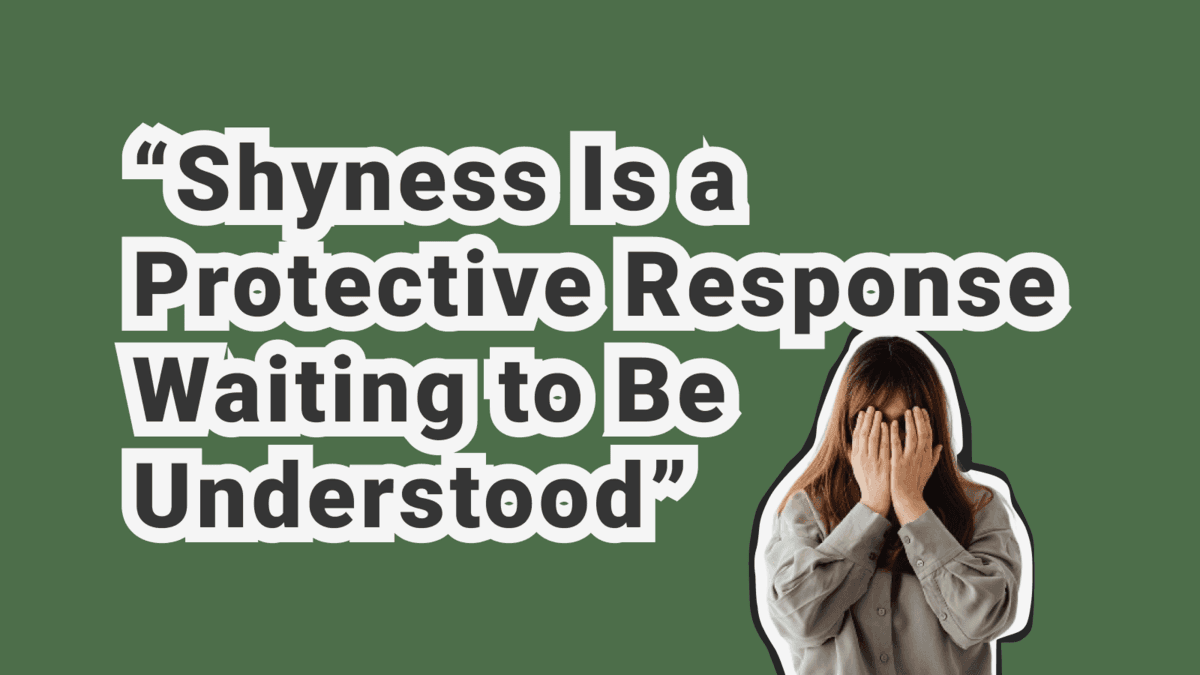
What is Shyness? The Unseen Dynamics Keeping You Silent Inside
Why do you stay silent when you have so much to say? We explore the fear of evaluation behind shyness, the traces of childhood, and your brain's protective mechanisms through an empathetic therapeutic lens.
Some people can sit in a crowded room for hours and leave without uttering a single sentence. Not because they have nothing to say; but because they think so deeply about how their words will be received and whether they might be judged...
Right in the middle of a conversation, a wonderful idea comes to mind. You feel a flutter inside and are just about to speak, but an invisible hand seems to tighten around your throat. You hesitate and pull back. And when you return home, lying in bed, that familiar internal echo begins:
"I wish I had said it... Why did I stay silent again?"
From the outside, this behavior is often labeled as coldness, bashfulness, or a lack of self-confidence. Yet, what we observe in the therapy room is entirely different. Shyness is not mere silence; it is a gentle yet exhausting armor that the mind and body build together to protect oneself from being hurt, appearing inadequate, or facing rejection.
Everyone feels shy from time to time. Entering a new environment or speaking to unfamiliar people can naturally trigger hesitation. But for some, this experience is not just a fleeting emotion; it becomes a heavy weight carried on their shoulders, spreading into every moment of life.
The fundamental, empathetic question we must ask here is this:
"Do shy people truly fear people themselves, or are they trying to protect themselves from the judgmental gaze of the human mind?"
In this article, we will examine shyness not merely as a theoretical concept, but through the light of that bodily tension you feel, your childhood memories, your brain's protective mechanisms, and the transformative journey of the therapy space.
Do Shy People Really Fear Other People?
Contrary to popular belief, most shy people deeply desire to form meaningful connections, to be understood, to converse genuinely, and to express themselves freely. Their hearts beat for connection.What feels overwhelming is not the desire to communicate; it is the perceived threat of being negatively evaluated during that communication.
Social psychology research and clinical observations reveal an \"internal censor\" constantly running in the minds of shy individuals. When entering a room, these whispers might circulate in your mind:
- "What if I say something wrong and make a fool of myself?"
- "What if my voice trembles and everyone notices my anxiety?"
- "What if they find me inadequate, boring, or awkward?"
- "It's best to stay quiet... If I don't speak, I stay safe."
As you can see, the core of this fear is not hatred for others or a lack of affection. At the very center lies the fear of your self-worth being bruised and a deep, invisible longing to be accepted.
Is Shyness a Destiny, or a Learned Protective Behavior?
Psychology does not offer a single answer to this question, because every human story is unique. Shyness is shaped both by a delicate biological temperament we are born with and by the experiences we live through.Research by developmental psychologist Jerome Kagan shows that some children are born with a nervous system that is more sensitive and cautious toward new stimuli (Behavioral Inhibition). These children naturally feel more deeply and observe more intently.
However, this temperament alone is not your destiny.
The family environment in which that delicate child grows up, a teacher's reaction to a mistake, the mocking laugh of a peer, or a felt sense of shame shapes that raw temperament.
In short: Temperament is your soil; your life experiences and how you were made to feel are what grow in that soil. In the past, your mind may have learned that "hiding" and "staying silent" was the safest way to protect you.
Why Does Your Brain Generate the Feeling That "Everyone Is Looking at Me"?
When you enter a crowded room or begin speaking in a group, have you ever felt as though a giant spotlight suddenly turned on above you, with every eye searching for your flaws?In cognitive psychology, this is known as the Spotlight Effect.
The human brain tends to overestimate the attention others pay to our anxiety and behaviors by a wide margin. In reality, people are mostly preoccupied with their own internal worlds, troubles, and thoughts. Yet, the protective mind of a shy individual instantly sounds the alarm:
"Everyone notices what you are doing. Be careful!"
This cognitive bias rapidly escalates anxiety levels in the body, leading the person to retreat further into their shell to protect themselves.
Constantly Monitoring Yourself: The Destructive Internal Camera
Have you ever noticed yourself watching your own actions from an outside perspective while talking to someone?"Where should I put my hands? Did my voice sound too weak? Did my smile look fake? Did I say something silly?"
In cognitive psychology, we call this Self-Focused Attention. Your focus detaches from the fluid conversation happening outside and locks entirely onto your own body and performance. Due to this excessive cognitive overload, even a natural sentence you could easily form suddenly turns into an impossible task.
The Mental Exhaustion After Returning Home: Nighttime Replays
The most exhausting part of shyness often begins after the social interaction has ended. Upon returning home, many shy individuals replay those conversations in their minds over and over, as if in slow motion. - "I wish I hadn't phrased it that way."
- "Why did I laugh like that? I'm sure they thought poorly of me."
- "Did I offend them, or did I embarrass myself?"
This process, defined in psychology as Post-Event Processing, is the mind inspecting the past interaction like a forensic investigator. Unfortunately, the mind is not neutral here; it only searches for flaws. This creates a tiring cycle that makes you approach future social situations with even greater anxiety.
Is Silence Always Shyness?
No. Not every person who stays silent in a group is shy.- Some people are introverted; they draw energy from solitude and do not feel a strong need to talk constantly.
- Some people simply prefer to observe.
- In shyness, however, the situation is different: Beneath the silence lies a profound desire to connect deeply, accompanied by an equally deep fear of evaluation.
Silence is the visible behavior. Shyness is the sensitive, vulnerable psychological process behind that behavior.
The Silent Price of Being the \"Good Child\" in Adulthood
Think back to your childhood... Did you grow up with messages like "Be a good child, don't make noise", "Don't misbehave, you'll embarrass us", or "What will people say?" Or was your innocent childhood excitement suppressed whenever you made a mistake?For a child, losing the love and approval of parents and caregivers feels like an existential threat. If "staying quiet and invisible" was learned as the pathway to avoiding criticism and gaining acceptance during childhood, the adult mind continues to use that exact same strategy.
Your shyness in adulthood may actually be a faithful childhood armor that once protected you, but has now become too tight.
The Internal Narrative of Shyness According to Schema Therapy
Schema therapy does not view shyness merely as superficial bashfulness. It looks at the deep-seated core beliefs etched into your identity over the years. Frequently encountered schemas include: - Defectiveness Schema: "If they see the real me, they will realize how inadequate I am."
- Social Isolation Schema: "I don't belong with these people; I am different/flawed."
- Approval-Seeking Schema: "To be valuable, I must be liked and approved of by everyone."
These schemas unconsciously run this quiet logic within you: "If I make a mistake, I lose my worth. Therefore, I must remain invisible."
Is Shyness the Same as a Lack of Self-Confidence?
Absolutely not. This is one of the biggest misconceptions. You can be highly competent in your field, successful in your profession, and immensely confident in your intellect and logic. Yet, when it comes to social evaluation and the emotional judgments of others, you may hesitate and pull back.Shyness is not inadequacy; it is heightened emotional sensitivity during moments of social evaluation.
### Your Brain's Evolutionary Effort to Protect You
From an evolutionary psychology perspective, our ancestors lived in small social groups where being ostracized meant being left alone in the wild—which meant death.
Therefore, the human brain coded social acceptance as a fundamental survival need, and social rejection as a physical threat.
When your heart pounds and your palms sweat before speaking in front of a crowd today, it is not a flaw. It is your brain's ancient alarm system trying to keep you safe from being cast out of the tribe. The alarm is simply calibrated a bit too sensitively for today's world.
How We Address Shyness in the Therapy Room
In psychotherapy, our goal is not to alter your personality or transform you into a completely different, aggressive individual. We know that within that silence lies immense depth, empathy, and a rich inner world.What we aim to do in the therapeutic process is:
- Gently soften that harsh, critical inner voice your mind built to protect you,
- Help your mind and body feel that making mistakes, feeling awkward, or being imperfect is human and safe,
- Build secure spaces where you can express your authentic self without fear, replacing avoidance behaviors with self-trust.
As you liberate yourself, you can slowly lay down that heavy armor and experience the lightness of letting your true voice be heard in the world.
In Conclusion
Shyness is not a fault, a deficiency, or a "disorder" that needs to be fixed. It is a deeply sensitive protective system carried within your mind.However, if this system now prevents you from realizing your potential, keeps you from forming the deep connections you long for, and traps you within yourself; you do not have to carry this burden alone.
If you would like to explore the rich world beneath your silence, untangle yourself from invisible armor, and begin a therapeutic journey where you are accepted as your authentic self, know that there is a safe space here for you.
Important Clinical Disclaimer
This content is prepared solely for informational and awareness purposes and does not constitute a clinical diagnosis or psychiatric evaluation. If you are experiencing anxiety or avoidance that significantly limits your daily life, relationships, or work, seeking individual therapy from a qualified mental health professional is recommended.
To create a session
You can quickly create a session request via WhatsApp or email by choosing the therapy package that best suits you.