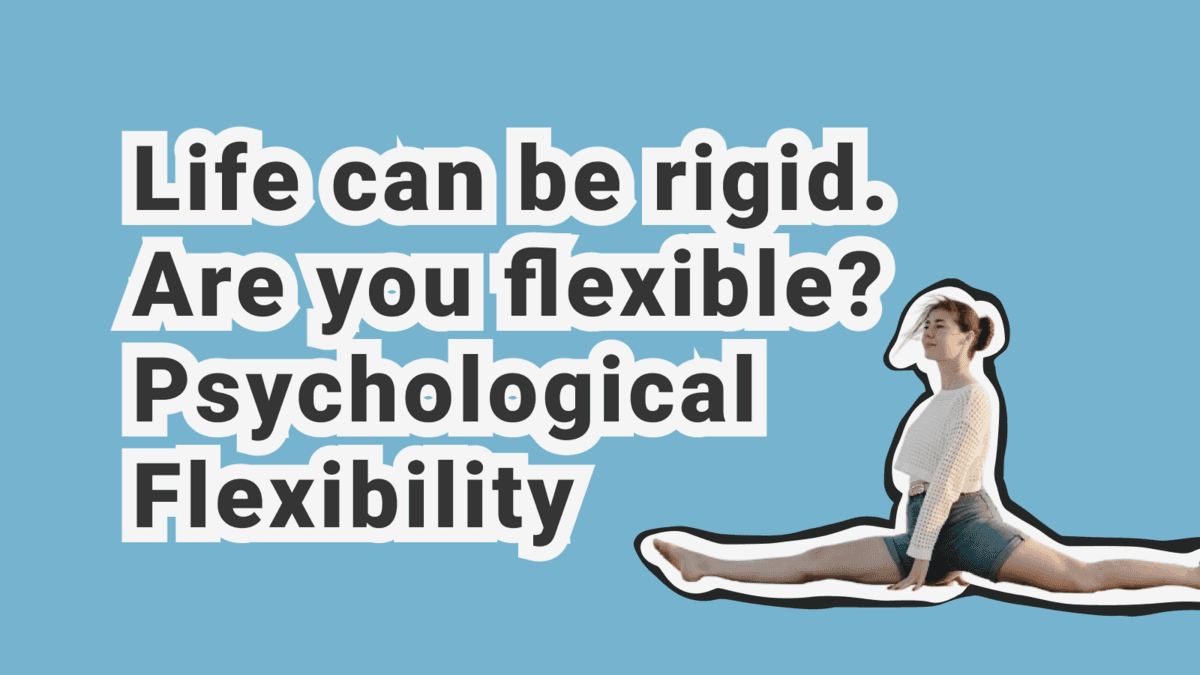
What Is Psychological Flexibility? A Marker of Mental Health? Coping With Difficult Emotions and Mental Resilience
Is psychological flexibility a sign of mental health? How can rigid thinking patterns change? A clear, science-based yet accessible guide to coping with difficult emotions, stress management, and building mental resilience.
Life is not always controllable. Unexpected events, difficult emotions, and uncertainty are a natural part of the human experience.
While some people adapt more easily to such situations, others may experience the same circumstances as more intense and overwhelming.
This difference is usually not about being “strong” or “weak.” Rather, it is related to the level of psychological flexibility.
Psychological flexibility refers to the ability to act in accordance with one’s values despite difficult thoughts and emotions.
What Is Psychological Flexibility?
Psychological flexibility is the capacity to stay in contact with one’s internal experiences instead of avoiding them, and to continue living a meaningful life despite those experiences.This concept has been particularly developed within Acceptance and Commitment Therapy (ACT). The core idea is not to eliminate difficult emotions, but to change the relationship with them.
Therefore, psychological flexibility does not mean always feeling good or having full control. Instead, it is reflected in the ability to stay on course even when difficult emotions are present.
Is Psychological Flexibility a Marker of Mental Health?
Current psychological research suggests that psychological flexibility may be an important indicator of mental health.Because psychologically flexible individuals:
- show less avoidance in response to difficult emotions
- respond more adaptively to stressful situations
- evaluate their thoughts instead of treating them as absolute reality
This is not only about symptom reduction. It is also about building a more stable and sustainable relationship with one’s inner experience.
Research shows that individuals with higher psychological flexibility tend to experience lower levels of depression, anxiety, and stress. Therefore, flexibility is considered not only a skill but also a core component of psychological well-being.
Why Do Some People Experience Struggles More Intensely?
How individuals respond to stress and uncertainty is largely shaped by past experiences and learned coping strategies.Some people tend to avoid, suppress, or try to control uncomfortable emotions. While these strategies may provide short-term relief, they can increase emotional rigidity over time and lead to greater avoidance of internal experiences.
Psychological flexibility, on the other hand, allows a person to stay in contact with these experiences. The goal is not to reduce the intensity of emotions, but to change their impact on the person’s life.
Cognitive Rigidity: Resistance to Different Perspectives
When psychological flexibility is low, not only emotional responses but also thinking patterns become rigid.Such individuals often:
- view their own thoughts as the only correct truth
- resist alternative perspectives
- filter new information through existing beliefs
From the outside, this may appear as stubbornness or inflexibility. Psychologically, however, it is often a protective mechanism.
The human mind naturally dislikes uncertainty. Therefore, holding onto familiar thought patterns creates a temporary sense of safety. In the long term, however, this rigidity can limit both relationships and personal development.
As psychological flexibility increases, individuals become more able to view different perspectives not as threats but as information to be considered.
Relationship With Thoughts: Are All Thoughts True?
The mind constantly produces interpretations, scenarios, and possible outcomes. However, not all of these mental events reflect reality.Individuals with higher psychological flexibility are able to see thoughts as mental events rather than absolute truths. This creates distance from thoughts and reduces identification with them.
As a result, a person begins to distinguish between “I am having the thought that…” and “this is true.” This distinction plays a key role in reducing anxiety and rumination cycles.
Staying With Emotions Instead of Avoiding Them
When difficult emotions arise, many people’s first reaction is to eliminate or avoid them. However, suppressed emotions often return with greater intensity.Psychological flexibility offers a different approach: noticing emotions and making space for them instead of fighting them.
This does not mean being overwhelmed by emotions. Rather, it means recognizing their temporary nature and allowing them to exist without being controlled by them.
Over time, this approach reduces the threatening impact of emotions and leads to a more balanced inner experience.
Values: The Internal System That Guides Behavior
One of the most critical components of psychological flexibility is staying connected with personal values.Values define what is meaningful in a person’s life. In difficult moments, many individuals lose this orientation and focus only on avoiding discomfort.
Psychological flexibility helps restore this direction. Even in the presence of difficulty, a person can continue acting in alignment with their values, which leads to a more fulfilling and coherent life in the long term.
Why Control Efforts Sometimes Backfire
The human mind naturally tries to control uncomfortable experiences. However, this effort often produces the opposite effect.The more a person tries to suppress a thought, the more frequently it tends to appear. Similarly, avoiding emotions can intensify them. In psychology, this is known as the “paradoxical effect.”
Psychological flexibility aims to break this cycle. Instead of control, it emphasizes acceptance combined with intentional redirection of attention.
How Psychological Flexibility Is Developed in Therapy
In psychotherapy, psychological flexibility is strengthened through mindfulness-based and experiential approaches.This process often involves:
- observing thoughts and creating distance from them
- increasing awareness of emotional experiences
- identifying avoidance patterns
- clarifying personal values
The goal is not only symptom reduction, but a fundamental shift in how a person relates to their inner world.
Supporting Psychological Flexibility in Daily Life
In daily life, psychological flexibility can be strengthened through small, intentional practices.For example, when a difficult emotion arises, instead of immediately reacting or avoiding it, a person can pause and simply notice it for a moment. Similarly, observing thoughts without trying to change them can create internal distance.
Over time, these small practices accumulate and contribute to a more stable capacity to manage stress, improving overall quality of life.
Conclusion
Psychological flexibility is not about eliminating difficult emotions, but about changing the relationship with them.Life’s uncertainties and challenges cannot be fully avoided. However, with a more flexible inner stance, it becomes possible to navigate them more effectively.
What matters is not controlling everything, but developing a healthier relationship with one’s experiences.
And often, real change does not begin when difficult emotions disappear, but when we learn to move forward with them present.
To create a session
You can quickly create a session request via WhatsApp or email by choosing the therapy package that best suits you.