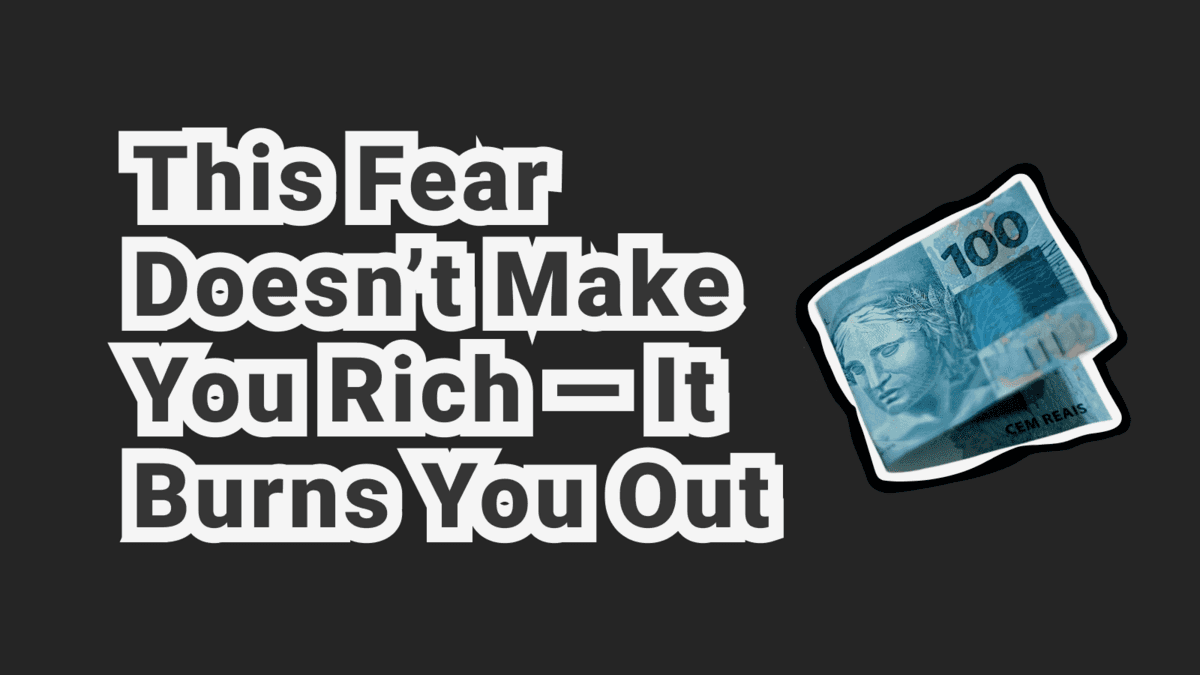
Why Am I Afraid of Running Out of Money? Understanding and Managing the Fear of Poverty
Why does the fear of being broke feel so intense? How do past experiences shape financial anxiety, and why can it lead to constant overworking? A psychological and practical guide.
Some people live with a persistent and often unspoken fear: the fear of running out of money, losing financial security, and falling into poverty.
This fear does not always reflect the person’s current reality. Even individuals who are skilled, educated, and financially stable may find themselves deeply disturbed by the mere thought of “having nothing.”
Over time, this leads to a recurring question:
“Why do I feel this way, even when things are objectively okay?”
In psychology, this state is often linked to financial anxiety, scarcity mindset, and sometimes deeper patterns rooted in past experiences. The key issue is not only money itself, but the meaning the mind assigns to it.
Why Does the Fear of Being Broke Arise?
The fear of financial loss is not random. The human mind is wired to seek safety and avoid threat. In modern life, money often becomes a symbolic representation of survival, control, and stability.For some individuals, especially those who have experienced financial hardship, instability, or uncertainty in the past, money is not just a resource — it becomes a psychological safety net.
Even if the current situation is stable, the mind may still operate as if the past threat is ongoing. It tries to prevent future loss by constantly staying alert.
As a result, the person may feel:
- “I must always be prepared”
- “I can’t relax”
- “If I slow down, I might lose everything”
This is not simply about finances.
It is about the fear of losing control and security.
When the Past Shapes the Present
Many intense fears around money are rooted in earlier life experiences.Growing up in a financially unstable environment, witnessing family stress around money, or experiencing sudden loss can leave a strong emotional imprint. The mind learns:
“Being without money is dangerous.”
Later in life, even if circumstances change, this internal belief may remain active.
The person may become highly capable, disciplined, and productive — but underneath that competence lies a constant tension.
In this sense, the fear is not irrational.
It is often a learned survival strategy that has outlived its original context.
The Productivity Trap: When Fear Drives Constant Work
One of the most common consequences of this fear is overworking.The person feels a continuous need to produce, improve, and stay ahead. On the surface, this may look like ambition or discipline. But internally, it is often driven by anxiety.
This can show up in subtle but powerful ways:
- Choosing quick, simple meals instead of taking time to cook and enjoy food
- Skipping leisure activities like watching a film or reading a book
- Feeling guilty when resting
- Constantly thinking about “what else I could be doing”
Even moments that should feel calm become uncomfortable.
Rest begins to feel like risk. Slowing down feels like falling behind.
Over time, life becomes less about living and more about preventing a feared future.
When Enough Never Feels Enough
A striking feature of financial anxiety is that “enough” keeps moving.No matter how much the person achieves or earns, the internal sense of safety does not fully settle. There is always a new threshold:
- “I need a bit more savings”
- “I should secure one more income stream”
- “I can’t afford to relax yet”
This creates a psychological loop where satisfaction is postponed indefinitely.
The issue here is not actual insufficiency,
but the absence of internal safety.
The Relationship Between Control and Anxiety
At the core of this fear often lies a deep need for control.Money, in this context, becomes a way to control uncertainty. The more unpredictable life feels, the more the person may rely on financial security as a stabilizing force.
However, this creates a paradox:
The more one tries to eliminate uncertainty completely, the more sensitive the mind becomes to any potential risk.
Small financial concerns may start to feel disproportionately threatening. The mind remains in a constant scanning mode, looking for possible problems.
Is This Fear Rational?
To some extent, concern about money is natural and even necessary. Financial planning, responsibility, and awareness are healthy.However, the question is not whether the fear exists,
but how intense and persistent it is.
When the fear:
- dominates daily thinking
- prevents rest or enjoyment
- drives constant pressure and tension
- disconnects the person from the present moment
it is no longer just practical concern —
it becomes a psychological burden.
The Emotional Cost of Constant Alertness
Living in a state of ongoing financial fear can have emotional consequences.The person may experience:
- chronic tension
- difficulty relaxing
- reduced enjoyment of simple experiences
- a sense of always being “on edge”
Over time, this can lead to burnout-like states, where the body slows down even if the mind keeps pushing forward.
The irony is clear: a system designed to protect the person begins to exhaust them.
Understanding the Underlying Belief
At the center of this pattern, there is often a core belief such as:- “If I don’t have money, I am not safe”
- “If I stop, everything will collapse”
- “I must always be productive to survive”
These beliefs are rarely questioned because they feel like facts. However, bringing awareness to them creates space for change.
The goal is not to deny reality, but to ask: “Is this belief still serving me today?”
What Can Be Done in This Situation?
Recognize the pattern
Noticing that the drive to constantly work is linked to fear — not just ambition — is a critical step.
Differentiate past from present
Understanding that current conditions may be different from past experiences helps the mind update its sense of safety.
Redefine productivity
Rest, enjoyment, and slow moments are not a waste of time. They are part of a sustainable life system.
Create intentional pauses
Even small, planned breaks (a meal enjoyed slowly, a short walk, a film) can help retrain the nervous system.
Question “urgent” thoughts
When the mind says “you must keep going,” it is useful to pause and ask:
“Is this truly urgent, or is this fear speaking?”
Strengthen internal safety
External security (money) matters, but developing a sense of internal stability is equally important.
When to Seek Support
If the fear of being broke begins to dominate life, limit enjoyment, or create constant pressure, it may be helpful to explore it more deeply.In some cases, this fear is connected to:
- anxiety patterns
- early life experiences
- chronic stress responses
Working through these patterns with professional support can help the person move from survival mode to a more balanced state.
Conclusion
The fear of running out of money is not just about finances.It is often about safety, control, and the mind’s attempt to protect itself from uncertainty.
While this fear can drive productivity and success,
it can also quietly take away the ability to rest, enjoy, and feel at ease.
Understanding this pattern does not mean becoming careless.
It means creating a different relationship with both money and fear.
Because security is not only something you build outside.
It is also something you learn to feel within.
To create a session
You can quickly create a session request via WhatsApp or email by choosing the therapy package that best suits you.